August 31, 2026
The Margin Stack
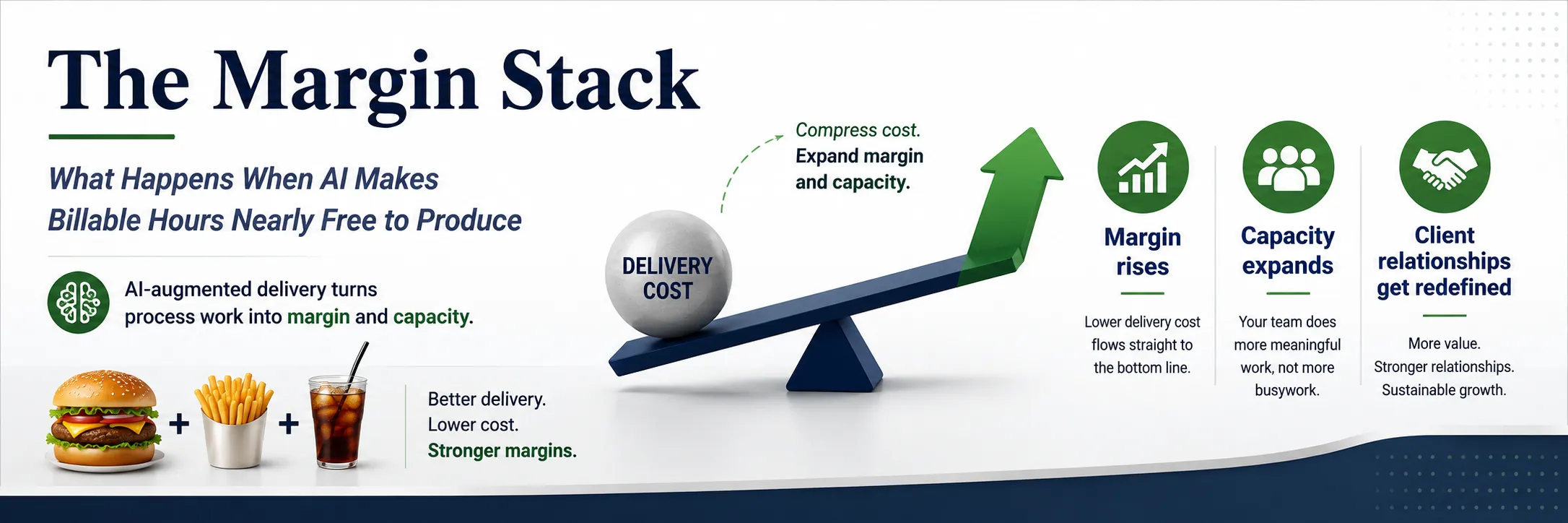
There's a question every partner at a professional services firm should be asking right now, and most aren't asking it clearly enough: if AI can compress the cost of delivering an hour of work without changing what the client pays for it, what happens to margin, capacity, and who wins the next decade of client relationships?
It's already happening in accounting, in law, in consulting, in any practice built on the billable hour. The firms that answer it first will have a structural advantage that's very hard for the rest of the field to close later.
The Business Model Nobody Says Out Loud
Professional services firms run on a pyramid. A small group of partners and directors sell the work and provide judgment. A much larger base of managers, seniors, and associates actually produces it. The economics depend on one unglamorous fact: junior hours are cheap to produce and expensive to sell.
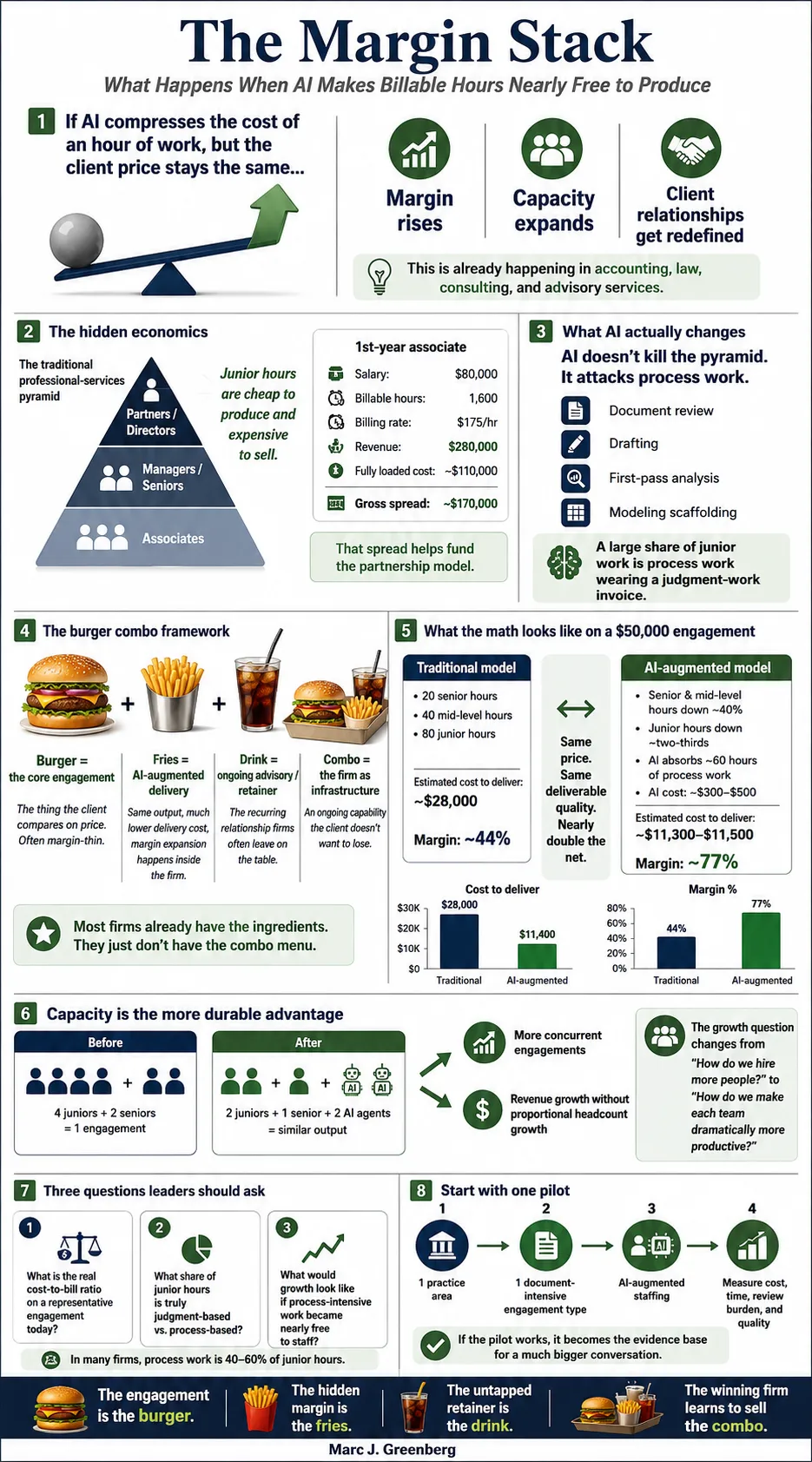
A first-year associate earning $80,000 a year might bill 1,600 hours at $175 an hour. That's $280,000 in revenue against a fully loaded cost of roughly $110,000. The spread, something like $170,000 per junior staff member, is what funds the partnership.
AI doesn't threaten that pyramid directly. It threatens the specific assumption underneath it: that junior labor is the only way to execute process-intensive work. Document review, drafting, first-pass analysis, financial modeling scaffolding. A meaningful share of what junior staff spend their hours on isn't really judgment work. It's process work wearing a judgment-work invoice.
Borrow a Framework From Fast Food
There's an old business parable about a burger chain that sells hamburgers at a loss. The burger is the draw. The real money is in the combo.
The burger is the core engagement itself: the forensic review, the valuation, the litigation support. It's the reason the client called. It's relationship-anchoring, and it's usually margin-thin, because clients are price-sensitive on the thing they can compare against a competitor's quote.
The fries are AI-augmented delivery: the same output, produced at a fraction of the cost, with the margin expansion happening entirely inside the firm, invisible on the client's invoice.
The drink is the ongoing advisory relationship: the retainer, the standing engagement that firms leave on the table after every matter closes because the team was too buried in process work to even propose it.
The combo is what happens when a firm stops selling hours and starts selling infrastructure: the firm itself, an ongoing capability the client can't easily walk away from.
The restaurant doesn't win because the burger is good. It wins because almost nobody orders just the burger.
What the Math Actually Looks Like
Take a representative $50,000 engagement, a solvency analysis or forensic review, structured and document-intensive, exactly the kind of work that scales well with AI-assisted document analysis and drafting.
Under a traditional staffing model, that engagement might run 20 senior hours, 40 mid-level hours, and 80 junior hours, for an estimated cost to deliver of about $28,000. Margin: roughly 44 percent.
Restructure the same engagement around an AI-augmented team, and senior and mid-level hours can drop by roughly 40 percent, junior hours by roughly two-thirds, with AI agents absorbing the equivalent of about 60 hours of process work. The invoice to the client doesn't change.
That AI contribution has a real cost. Document-heavy work like this, run through frontier models, typically costs somewhere in the low hundreds of dollars in compute and tooling for an engagement this size, a rounding error next to the labor it replaces, but not zero, and it belongs in the math rather than left out of it. Folding in a generous $300 to $500 for that cost, the total cost to deliver comes in around $11,300 to $11,500. Margin: roughly 77 percent.
That's still nearly doubling the net on the same engagement, at the same price, with the same deliverable quality. What changed was how much of the team's time went into work that never should have required a human in the first place, and the AI's own cost stayed small enough not to matter.
Capacity Is the Bigger Story
Margin gets the headline, but capacity is the more durable advantage. If a team of two juniors, one senior, and two AI agents can deliver what previously required four juniors and two seniors, that same team can now run multiple engagements at once. In a business development-constrained world, that's revenue growth without proportional headcount growth.
This also reframes the growth conversation. It's no longer just "how do we hire more people." It becomes "how do we make each team dramatically more productive while keeping the client relationship intact."
The Industry Already Feels This Coming
Leadership at the larger firms already senses this. One national accounting and advisory firm, a couple hundred professionals in its advisory practice, appointed its first Chief AI Officer in early 2025 with a mandate to find where AI adds client and operational value. Its CEO has said publicly, in effect, that staying competitive means getting more innovative products and information to clients faster, and that AI is a path to that. The intent is there at the top of a lot of firms right now. What's usually missing is the operational bridge from that intent down to how an actual engagement gets staffed and priced.
Three Questions Worth Asking Before You Do Anything Else
Before any firm restructures how it delivers work, three questions deserve an honest answer, not the reflexive one.
What is the actual cost-to-bill ratio on a representative engagement today? Most partners are guessing.
What percentage of current junior hours are truly judgment-based versus process-based? The instinctive answer is "most of it is judgment." Looked at closely, the process share is usually 40 to 60 percent. That's where the leverage lives.
What would it mean for growth if process-intensive work became nearly free to staff? That's the real strategic question.
Where to Start
Not with a firm-wide initiative. With one contained pilot, in one practice area, on one well-defined, document-intensive engagement type. Staff it with an AI-augmented team, track cost to deliver, time to completion, and partner review burden against a comparable historical engagement, and measure whether quality holds. If it does, that pilot becomes the evidence base for a much bigger conversation.
The burger is the engagement. The fries are the margin nobody is capturing yet. The drink is the retainer sitting untapped after every matter closes. Most firms already have all three ingredients sitting in the kitchen. What's missing is the combo menu, and an operational model to serve it consistently at scale.
Marc J. Greenberg is Co-Founder and CTO of Beyond Limited Thinking, and works with advisory and professional services firms as a fractional CTO through Braintrailz and Codemarc Consulting, helping practice leaders turn AI from a headcount question into a margin and capacity question.